
EXPLAINED: Demand and Supply
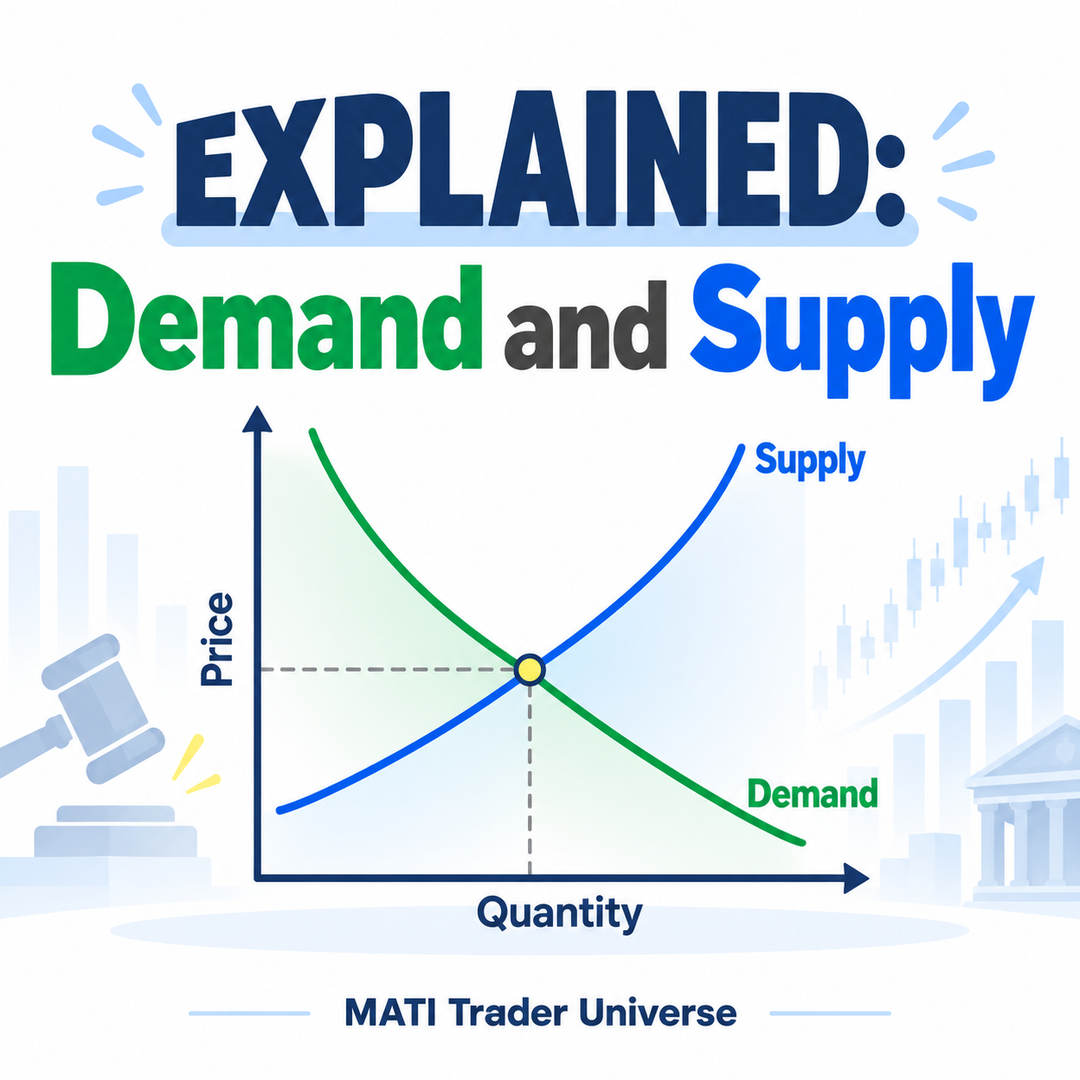
Supply and Demand
Hi MATI Trader! Remember our big auction? Supply is how much sellers are willing to offer; demand is how much buyers want at different prices. Where their willingness meets, trades can happen. As those orders change, so can the price.
Buyers step in
When buyers become more eager and the available offers cannot satisfy them at the current price, they may bid higher. That pressure can lift price.
Sellers step in
When sellers are more eager and there are not enough buyers at the current price, they may accept lower bids. That pressure can push price down.
Try the auction lab
Change who is more eager. Watch the illustrative price response, then think about why it happens.
Orders are balanced in this simplified example.
Could a trader use this?
Yes: our slides show two broad possibilities—anticipate rising prices and buy, or anticipate falling prices and sell where the product allows it. But spotting pressure is only the beginning. Decide where your idea is wrong, manage your position size, and account for costs; demand can disappear just when you think it looks unstoppable.
Your first trading habit
Before calling a move “bullish” or “bearish,” ask: Who seems more eager right now, and what would change my mind? A strong chart move shows what happened, not what must happen next.
Quick quiz: Read the auction



Trade well, live free.
Timon Rossolimos
Founder, MATI Trader
CONNECT WITH US:
Facebook Group:
http://www.facebook.com/groups/matitrader
Website:
https://timonandmati.com
FREE MATI Trader Chat Room – Discord:
https://discord.gg/c8f37kyv35

Trade well, live free.

Timon Rossolimos
Founder, MATI Trader
Not sure the best way to get started with MATI Trader?
Follow these steps to start your successful trading journey.
Step #1 – Get The FREE MATI Trader Resources:
> MATI Trader System Programme Lesson 1
> Articles
Step #2 – Own The Complete MATI Trader System:
> MATI Trader System Programme
Step #3 – Become A VIP:
> Premium MATI Trader Service